Outsourcing your executive functions: how AI helps when you have ADHD and run out of mental energy
If you have ADHD, your brain doesn't struggle with ideas. It struggles with the invisible steps between the idea and the first sentence. A guest post by ADHD coach Yann Ghisalberti on three ways AI can carry that load.
 Yann GhisalbertiGuest post3 min read
A guest post by Yann Ghisalberti, an ADHD and AuDHD coach based in the Netherlands who works with adults, teenagers (12+) and parents dealing with late diagnosis, burnout and neurodivergent life.
If you have ADHD, your brain does not struggle with ideas. It struggles with the invisible steps required to execute those ideas. Artificial intelligence is often sold as a way to write emails faster or generate marketing copy.
But for a neurodivergent brain, it is something much more practical. It is a way to outsource your executive functions. It does the sequencing, initiating and sorting that our frontal lobes find so exhausting when we are running on empty.
Imagine it is Tuesday at 14:00. You are staring at a blank document. You know exactly what you want to say in the report. You have the data. You have the expertise. But the distance between your brain and the first sentence feels like a glass wall you cannot climb. So you go and reorganise your inbox instead.
The standard advice you have probably heard for years is to "just break the task down into smaller steps".
But breaking a task down requires executive function. It demands working memory to hold all the pieces in your head, and sequencing skills to put them in a logical order. When your battery is already empty, telling you to break a task down is like telling someone with a broken leg to walk to the hospital.
This is where AI changes the reality of working with ADHD.
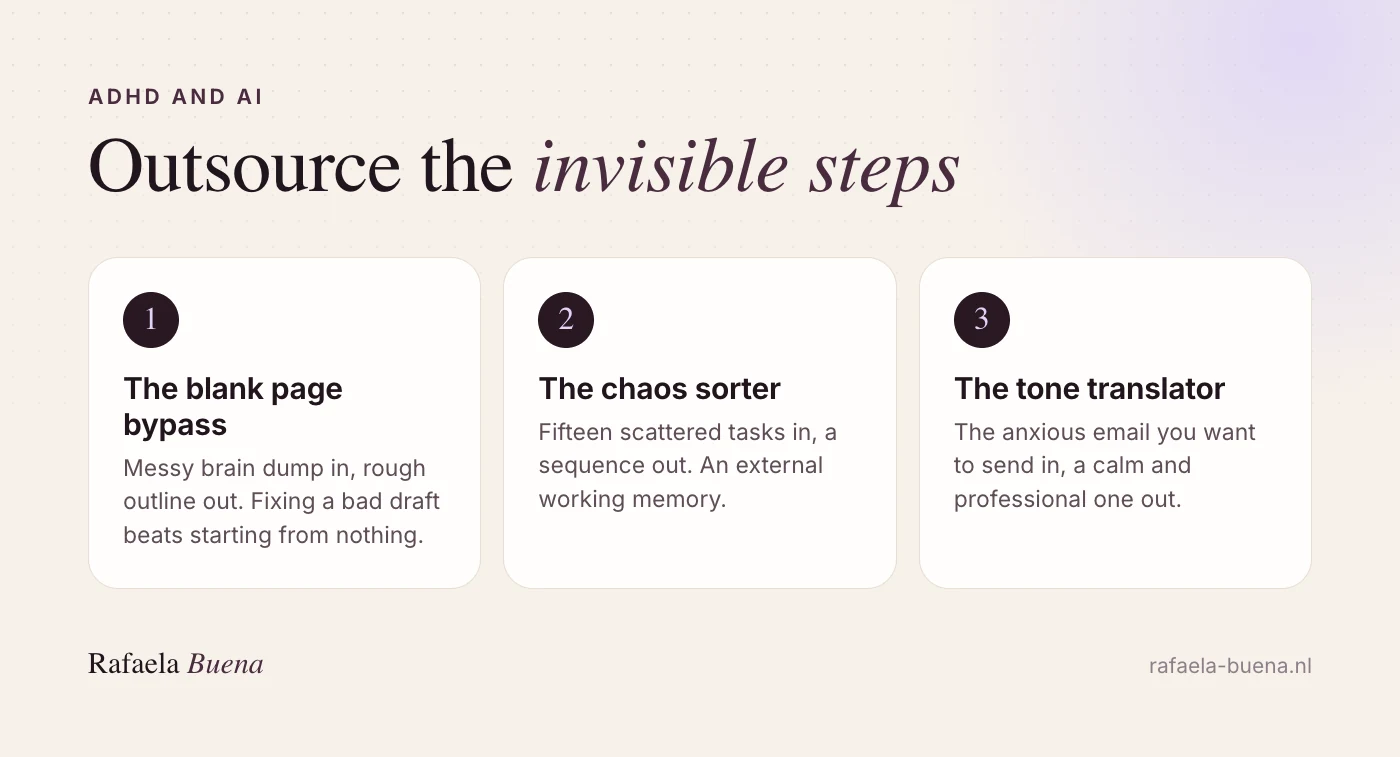
1. The blank page bypass
Task initiation is often the heaviest lift for an ADHD brain. The blank page is paralysing because it is completely unstructured. You do not know where the boundaries are.
Instead of forcing yourself to write a perfect first paragraph, you can bypass the blank page entirely. You type a messy, unstructured brain dump into AI:
"I need to write a report about Q3 sales. We did well in August but September was slow because of the software migration. We need more budget for Q4."
You ask the AI to turn that into a rough outline. The draft it gives you might be terrible. That is completely fine. It is infinitely easier for an ADHD brain to correct a bad draft than to generate a new one from scratch. The glass wall disappears because there is suddenly something on the page to fix.
2. The chaos sorter
When a project feels overwhelming, it is usually because all the steps look equally urgent. The brain tries to do them all at once, gets overloaded, and freezes.
You can give an AI your scattered list of thoughts and ask it to sequence them:
"Here are 15 things I need to do for the upcoming workshop. Put them in order of what needs to happen first, and group the related tasks."
The tool acts as an external working memory. It holds the pieces so you do not have to, allowing you to focus on simply doing step one.
3. The tone translator
People with ADHD often deal with emotional regulation challenges and rejection sensitivity. Sending a difficult email, setting a boundary, or asking a client to pay overdue invoices can cause a massive spike in anxiety.
You can write the angry, defensive or anxious email you actually want to send in a private prompt. Then you ask the AI to make the tone professional, warm and objective. It removes the emotional tax from your communication and lets you hit send without second-guessing every word.
Briefing the AI is the exercise
As Rafaela Buena points out in her workshops, the quality of AI output depends on the quality of your briefing. You have to define what you want. For an ADHD brain, the act of briefing the AI is actually the exact process we need to untangle our thoughts. You are forced to define the outcome, which clears the mental fog.
If you are spending your days surviving your workload on willpower alone, try offloading the invisible steps. AI will not do the work for you, but it will help you start.
To learn more about finding accommodations that actually fit your brain, visit coach4adhd.nl or book a free discovery call with Yann.
Keep reading
All posts
6 min read
How I use Claude to run my social media and clean up my digital life (a real week, no code)
Last week I handed Claude my social media, my old TikToks and my messy folders. I’m not an engineer. Here’s exactly what it did, what went wrong, and how you can start.
Read the post
4 min read
How to choose an AI trainer for your team: 9 questions to ask
Hiring an AI trainer or AI workshop for your team? Nine questions that separate training people actually use from a slide deck they forget by Friday.
Read the post
5 min read
AI literacy under the EU AI Act: what employers actually need to do
Article 4 of the EU AI Act asks employers to support staff AI literacy. What it means in plain English, what changed in 2026, and a practical 5-step plan.
Read the postOnline course · opens December